
01 / The Central Idea
There are always two systems.
Most assessments begin by asking whether reality conforms to design.
We start by asking why it does not.
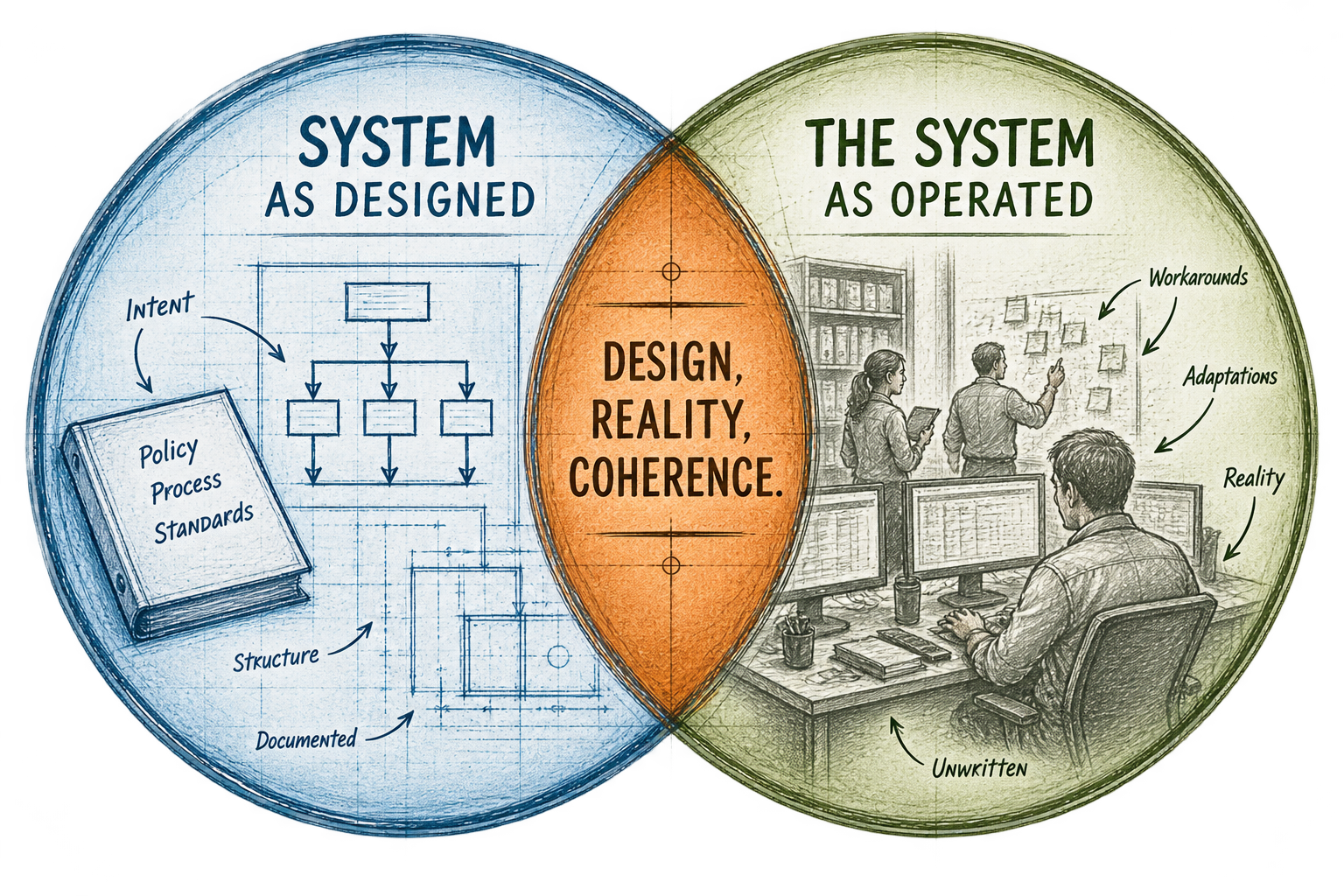
The workaround is not automatically a failure. The deviation is not automatically noncompliance. The undocumented process is not automatically bad behavior. It is information.
Before an organization can decide whether an adaptation should be preserved, corrected, formalized, redesigned, or eliminated, somebody has to understand why it exists.
That is the Tuesday Assessment.
02 / Operational Signals
We look for the places where reality leaves fingerprints.
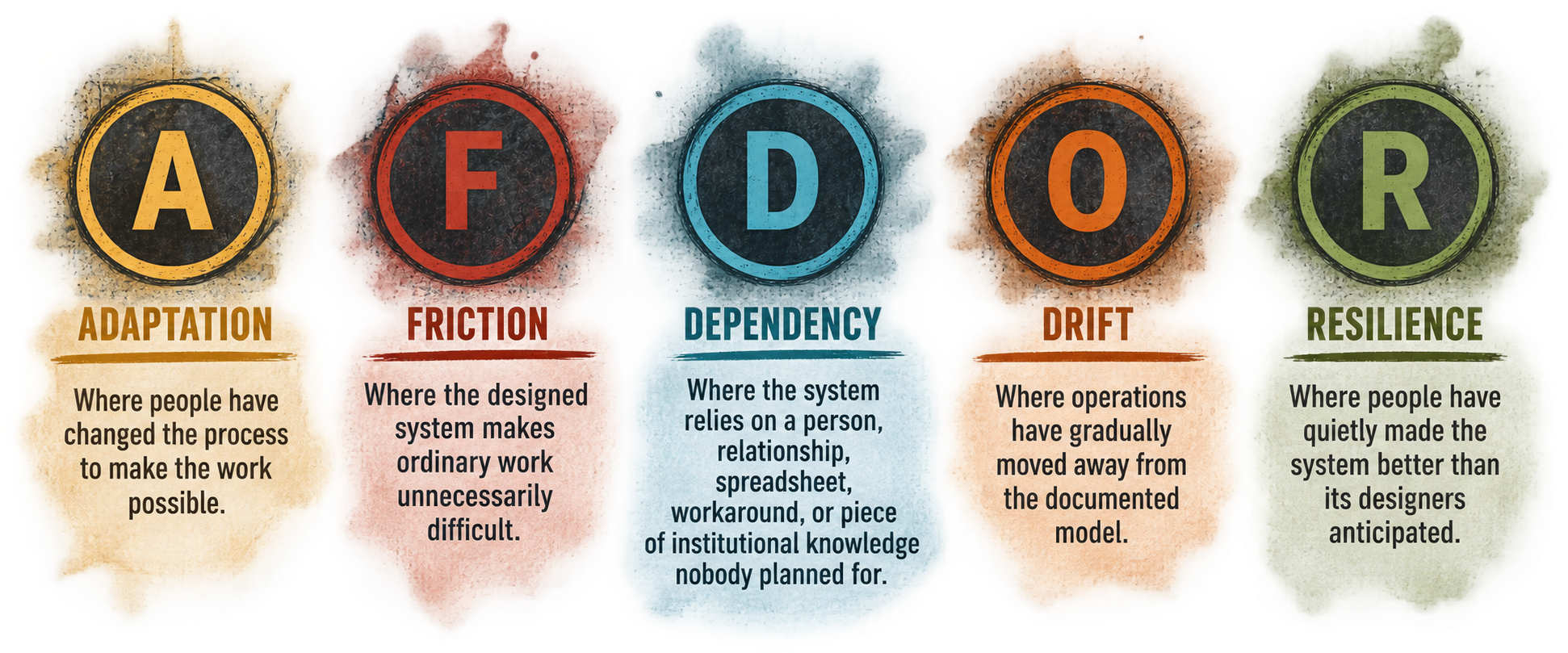
03 / How the Assessment Works
A Tuesday Assessment has a rhythm.
Establish the Design
We learn what the system is supposed to do—policies, procedures, controls, architecture, roles, metrics, and expectations. Not to determine whether they are being followed. To understand the original intent.
Follow the Work
We go where the work happens. We talk with the people who operate the system, observe workflows, follow handoffs, and ask what happens when the normal path does not work. Most importantly, we ask people to show us.
Find the Distance
We compare design with operation. Where do they align? Where have they separated? Where has adaptation created risk—or removed friction? Where does nobody actually know anymore?
Understand Why
We do not recommend fixing something until we understand why it changed. A workaround may exist because someone ignored the process—or because the process is impossible. Those demand very different responses.
Make It Visible
We deliver a concise picture of what was designed, what actually happens, where they differ, why they differ, and what deserves attention. Then leadership decides what happens next.
04 / What You Get
No 200-page deck.
Operational Reality Map
A visual representation of the system as it actually operates.
Adaptation Register
Documented workarounds, deviations, informal processes, and operational adaptations—with context rather than judgment.
Friction & Dependency Findings
The places where systems, processes, tools, or organizational boundaries make the work harder or more fragile.
Risk & Resilience Observations
Where operational reality introduces meaningful exposure—and where it has quietly improved the system.
Leadership Brief
A concise synthesis of what matters, why it matters, and where leadership attention is warranted.
Design Reconciliation
A prioritized set of decisions: preserve, formalize, investigate, redesign, or retire. Not a transformation roadmap.
05 / Rules of Engagement
This only works if people can tell the truth.
Reality is evidence.
We do not hunt for violations.
We look for information.
We do not begin with blame.
We begin with understanding.
We do not assume deviation is failure.
Sometimes adaptation is the thing keeping the system alive.
We do not identify operators for punishment.
People need to be able to describe how work actually happens.
We do not arrive with the answer.
If we already knew what was wrong, there would be no reason to conduct the assessment.
06 / Who It Is For
Tuesday is useful when…
- Your documentation looks right, but something still feels wrong.
- Audits keep finding the same issues.
- A process technically works, but everyone hates using it.
- One person seems to know how everything actually gets done.
- A system has accumulated years of exceptions and workarounds.
- Leadership suspects operational risk but cannot locate it.
- A transformation, migration, or redesign is approaching—and you want to understand reality before changing it.
Engagement at a Glance
- Typical duration
- 2–3 weeks
- Engagement
- Fixed scope
- Best suited for
- A defined system, process, service, function, or operational boundary
- Participants
- Leadership + the people who actually perform the work
- Outcome
- A defensible picture of operational reality and the decisions it creates
- Investment
- Scoped by engagement
07 / Start Here
Let’s see what reality looks like.
Show us Tuesday.